Resources
Who pays, and where the risk passes.
All eleven Incoterms® 2020 rules on one chart, with what each one means for your shipment.
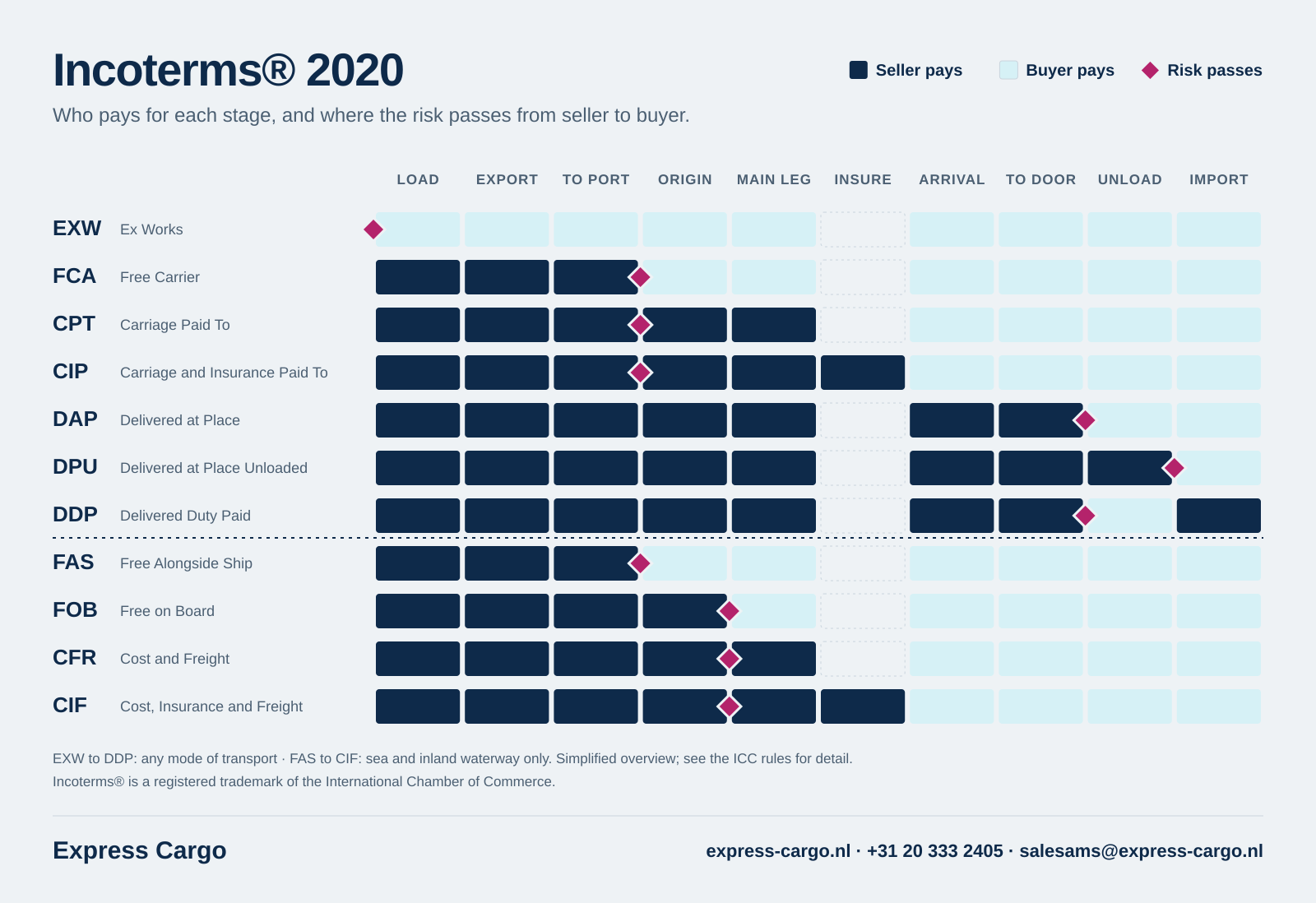
Incoterms® 2020 chart
- Seller pays
- Buyer pays
- Risk passes
| Rule | Load1Packing and loading at origin | Export2Export customs clearance | To port3Pre-carriage to the port or terminal | Origin4Origin terminal handling and loading | Main leg5Main carriage (air or sea freight) | Insure6Cargo insurance | Arrival7Destination terminal handling | To door8On-carriage to the named place | Unload9Unloading at destination | Import10Import clearance, duties and taxes |
|---|---|---|---|---|---|---|---|---|---|---|
| EXWEx Works | Buyer, risk passes here | Buyer | Buyer | Buyer | Buyer | Not required | Buyer | Buyer | Buyer | Buyer |
| FCAFree Carrier | Seller | Seller | Seller, risk passes here | Buyer | Buyer | Not required | Buyer | Buyer | Buyer | Buyer |
| CPTCarriage Paid To | Seller | Seller | Seller, risk passes here | Seller | Seller | Not required | Buyer | Buyer | Buyer | Buyer |
| CIPCarriage and Insurance Paid To | Seller | Seller | Seller, risk passes here | Seller | Seller | Seller | Buyer | Buyer | Buyer | Buyer |
| DAPDelivered at Place | Seller | Seller | Seller | Seller | Seller | Not required | Seller | Seller, risk passes here | Buyer | Buyer |
| DPUDelivered at Place Unloaded | Seller | Seller | Seller | Seller | Seller | Not required | Seller | Seller | Seller, risk passes here | Buyer |
| DDPDelivered Duty Paid | Seller | Seller | Seller | Seller | Seller | Not required | Seller | Seller, risk passes here | Buyer | Seller |
| FASFree Alongside Ship | Seller | Seller | Seller, risk passes here | Buyer | Buyer | Not required | Buyer | Buyer | Buyer | Buyer |
| FOBFree on Board | Seller | Seller | Seller | Seller, risk passes here | Buyer | Not required | Buyer | Buyer | Buyer | Buyer |
| CFRCost and Freight | Seller | Seller | Seller | Seller, risk passes here | Seller | Not required | Buyer | Buyer | Buyer | Buyer |
| CIFCost, Insurance and Freight | Seller | Seller | Seller | Seller, risk passes here | Seller | Seller | Buyer | Buyer | Buyer | Buyer |
- 1 Packing and loading at origin
- 2 Export customs clearance
- 3 Pre-carriage to the port or terminal
- 4 Origin terminal handling and loading
- 5 Main carriage (air or sea freight)
- 6 Cargo insurance
- 7 Destination terminal handling
- 8 On-carriage to the named place
- 9 Unloading at destination
- 10 Import clearance, duties and taxes
-
Any mode of transport
EXW Ex Works
Risk passes At the seller’s premises, goods made available, not loaded.
The buyer does everything, including export clearance in the seller’s country. Often a poor fit for exports outside the EU.
-
Any mode of transport
FCA Free Carrier
Risk passes When handed to the buyer’s carrier at the named place (loaded, if that is the seller’s premises).
The usual choice for air freight and containers: the seller clears export, the buyer books the main leg.
-
Any mode of transport
CPT Carriage Paid To
Risk passes When handed to the first carrier, although the seller pays carriage to destination.
Cost and risk split at different points: the buyer carries the risk of a leg the seller paid for.
-
Any mode of transport
CIP Carriage and Insurance Paid To
Risk passes When handed to the first carrier.
As CPT, plus insurance by the seller at the highest level of cover (Institute Cargo Clauses A).
-
Any mode of transport
DAP Delivered at Place
Risk passes At the named destination, on the arriving vehicle, ready for unloading.
The seller delivers to the door; the buyer unloads and clears import.
-
Any mode of transport
DPU Delivered at Place Unloaded
Risk passes At the named destination, once unloaded.
The only rule where the seller unloads at destination. Replaced DAT in 2020.
-
Any mode of transport
DDP Delivered Duty Paid
Risk passes At the named destination, ready for unloading, import cleared.
Maximum obligation for the seller, including import duties and taxes in the buyer’s country.
-
Sea & inland waterway
FAS Free Alongside Ship
Risk passes Alongside the vessel at the port of shipment.
Bulk and break-bulk cargo; not meant for containers.
-
Sea & inland waterway
FOB Free on Board
Risk passes On board the vessel at the port of shipment.
Sea and inland waterway only. For containers, ICC recommends FCA instead.
-
Sea & inland waterway
CFR Cost and Freight
Risk passes On board the vessel at the port of shipment, although the seller pays freight to destination port.
Sea and inland waterway only. For containers, CPT is the closer fit.
-
Sea & inland waterway
CIF Cost, Insurance and Freight
Risk passes On board the vessel at the port of shipment.
As CFR, plus minimum insurance cover by the seller (Institute Cargo Clauses C).
A simplified overview for planning. The full rules, including where costs such as terminal handling fall in your contract of carriage, are in the ICC publication. Incoterms® is a registered trademark of the International Chamber of Commerce. Not sure which rule fits? Ask your coordinator.
Useful links.
The sources we use ourselves, for rules, customs, dangerous goods and tracking.
Rules & trade
- ICC: Incoterms® rulesThe official source, from the International Chamber of Commerce.(opens in a new tab)
- EU TARICCommodity codes, duty rates and measures for the EU.(opens in a new tab)
- EORI number checkValidate a company’s EU customs registration.(opens in a new tab)
- Dutch Customs (Douane)Import, export and declarations in the Netherlands.(opens in a new tab)
Dangerous goods & pharma
- IATA Dangerous Goods RegulationsThe rules for shipping dangerous goods by air.(opens in a new tab)
- IATA lithium battery guidancePacking and labelling for UN3480, UN3481, UN3090 and UN3091.(opens in a new tab)
- IATA pharma (CEIV Pharma)The industry standard for temperature-controlled pharma.(opens in a new tab)
- EnvirotainerActive temperature-controlled air cargo containers.(opens in a new tab)
Tracking
Questions
Questions, answered.
What are Incoterms?
Incoterms® 2020 are eleven rules published by the International Chamber of Commerce. Each one defines which party arranges and pays for each stage of transport, and where the risk passes from seller to buyer.
Which Incoterms are only for sea freight?
FAS, FOB, CFR and CIF are meant for sea and inland waterway transport only. The other seven (EXW, FCA, CPT, CIP, DAP, DPU and DDP) can be used for any mode, including air freight.
What is the difference between CIF and CIP?
Both make the seller pay carriage and insurance. CIF is for sea and inland waterway and requires minimum cover (Institute Cargo Clauses C). CIP works for any mode and requires the highest cover (Institute Cargo Clauses A).
What is the difference between DAP, DPU and DDP?
With all three the seller delivers to the named destination. Under DAP the goods arrive ready for unloading; under DPU the seller also unloads them; under DDP the seller also clears import and pays the duties and taxes.
Should I use FOB for container shipments?
ICC recommends FCA instead. With containers the goods are usually handed over at a terminal before they are loaded on board, which FCA describes and FOB does not.
Rule chosen? Let’s move it.
Tell us the Incoterm, origin and destination. Quotes go out fast.